Monday, 29 October 2012

Carnarvon to Denman and Monkey Mia.

After leaving Carnarvon we were back to a flat, arid, treeless landscape which instantly sent me nodding off. In no time at all, surprisingly, we were at Gladstone lookout, a mesa which had three weird cairns assembled out of rocks with messages written on them. They were a mixture of memorials to departed loved ones, autographs of travellers, a large assortment of gnomes, bras, teapots and stuffed animals! In quite a few places we've seen various collections of thongs, workboots, underwear, hard hats, postcards, photos. All except the last two were hanging on trees.

We spent the night at Hamelin Pool Station, which had the very best amenities block we've ever seen and a camp kitchen equally as good. The bird life was amazing, and together with a young family of avid twitchers with keen eyes and impressive knowledge, we saw the White-Winged and Splendid Fairy-wrens, the Red-kneed Dotterel, Common Greenshank, Eurasian Coot and a Whiskered Tern, as well as three Brown Falcons on the roof of the old barn. A great day!

Stromalite
The next morning, we went to Hamelin Pool Marine and Nature Reserve to look at the Historic Telegraph Station and the stromatolites. The stromalites are colonies of micro-organisms that resemble the oldest and simplest forms of life on earth around 3.5 billion yrs ago. They were the first life-form which produced oxygen which enabled other forms of life to evolve.
fabulous shadows cast by walkway over stromalite beds.
 
An old wool dray and water tank behind.... exhibits in the museum precinct at the Historic Telegraph Station.
The Shearing Hall Of Fame had an excellent collection of memorabilia relating to the pastoral and shearing industries, a huge range of steam engines, trucks and farm machinery, as well as the salvaged lifeboat from the German raider Kormoran which was responsible for the demise of HMAS Sydney II, in1941. The photographic display documenting the shearing industry and the life of local families in the 1950s was impressive. Also documented was the development of the railhead which facilitated the loading of wool onto ships for transport to Perth. Even more amazing was the fact that the museum was open and unattended!

One Mile Jetty which is currently being restored.
Nearby is the One Mile Jetty, built in 1897 to facilitate the export of wool and livestock to Freemantle. As we were walking out onto the jetty, two Aboriginal boys passed, dripping wet and carrying hand spears. They pointed to the men we could see on the beach and said they were going to fish with them. They had already caught big mullet they said. The younger boy who was about eight called the older boy, about 13, 'uncle'. We were pleased to see traditional Aboriginal culture in action as it underpins a sense of identity.
We are constantly amazed by the work done in NP and Reserve areas to protect and maintain pristine areas, while at the same time encouraging tourists to explore and enjoy them. The signage, amenities and information available is remarkable. Our annual Western Australia NP Pass, which cost a mere $50, gives us access to every NP in the state, and is well worth the expense. Camping fees within the parks are $5 pp pn, for seniors or $7pp. + $11 park entry without an annual or seasonal pass.
Today, we drove to Denham, stopping on the way to look at a few bush campsites we'd heard about along the coast and then went to Eagle Bluff. There is a boardwalk high above Shark Bay from which you can sometimes see Dugongs, rays and sharks swimming above the vast seagrass beds, but, unfortunately, it was so windy we were almost blown off the face of the planet and retreated to the car!

We also stopped to look at Shell Beach which consists entirely of shells to a depth of 10 metres. The most interesting thing was the electric fence crossing the isthmus which Is designed to keep feral animals out of the Francois Peron NP. There is a considerably successful programme of eradication of goats, rabbits, cats and foxes and reintroduction of threatened native species such as the bilby.
Denman is a pretty, seaside town with a Visitors Centre where we obtained all the information we needed for entry to Monkey Mia and the Francois Peron NP.
We bought a few supplies and drove to Monkey Mia. The resort has a lot of accommodation and tour options, restaurant, canoes for hire, shop and attractive beach with a jetty. There is a no go zone for boats and swimming where the dolphins are fed daily.
The next morning the beach was lined with tourists waiting for the dolphins to come in for the first feeding session of the day. Eventually, there were six which rolled, smiled and performed for the tourists and gratefully accepted the fish on offer.
After packing up and vacating the caravan park, we went on a catarmaran cruise for 2.5hrs, spotting dolphins, dugong and turtles. We saw a lot of dugongs for the first time in the wild. They surface briefly for air and then continue feeding on the extensive sea grass beds which occur in this area. Some of them were sleeping and looked like large, blubbery, brown lumps on the surface of the sea.

Our captain ....... Left foot on accelerator and right foot on steering wheel. Head stuck out wildlife spotting!!!!!!
The cruise also took us to a working pearl farm where we tasted pearl meat for the first time. It was surprisingly sweet. We saw the delicate the work of seeding the pearls, where the seeder opens the shell with special spreaders, then uses a scalpel to cut a small slit in the flesh where the seed is implanted. Over a period of time the seed is covered with nacre (mother of pearl), as the oyster tries to get rid of the foreign seed. A round pearl takes considerably longer to form than a blister pearl. That is the main reason why blister pearls are less expensive.

 
We planned to go into The Francois Peron NP but decided against going further than the homestead because the conditions were not suitable for trailers or vans. The strong, constant winds were also unpleasant. We backtracked to Denman to the visitors Centre for a camping permit and went to Eagle Bluff for the night. It was a bit protected in behind the dunes and we had no sooner set up, than the family from the night before arrived. They told us they got bogged on the way into the Francois Peron NP and had to dig themselves out of the sand, so they turned back. It was great to have some company and people to share some of the vanilla slice I'd made. They have 8yr old twin girls and an 11yr old boy.

Eagle Bluff campsite.

The wind dropped the next morning and we spent a pleasant few hours on the beach with nary a soul to be seen. Bliss! We revisited Eagle Bluff and saw huge manta rays and at least 10 sharks at one count in the waters below. No wonder it's called Shark Bay and lucky we were swimming/lolling in ankle deep water only, just before.

After lunch we covered a bit of distance and free camped at Nerren Nerren under a large shady tree, about 120kms short of Kalbarri.

Cards score: Glenn 14 Jenni 18


Canarvon WA 20.10.12

It was great to see the change from arid, treeless plains to the lush productive plantations of the Gascoyne River as we approached Carnarvon. We checked into the Big 4 caravan park which has more don'ts than do's. Washing machines are $5, the most expensive we have seen so far and there is an extra DIY charge of $5 each to wash car or van. Makes me wonder what the nightly tariff of $35 is for and explains why there are enormous numbers of travellers opting for off road camping, especially as most have toilet and shower facilities of their own.

We spent the morning catching up on washing, email etc. and then went to the pub for lunch. We sat overlooking Carnarvon's central waterway, known as the Fascine (literal meaning is 'water held back by sticks'), which is lined with palm trees and ate very good snapper, prawns, squid and scallops with a cold beer!

From there we drove along the memorial drive where there is a plaque stating the name and rank of every man who perished on the HMAS Sydney II, and a palm tree growing behind. A big effort we thought.

The town is dominated by the OTC dish which was built in conjunction with NASA and was involved in the Apollo space missions. We climbed to the platform from where there is a panoramic view of the town, plantations and surrounding countryside. The phone rang while we were standing there and I had a long conversation with my brother Peter. The reception was excellent... maybe due to the height!


The plantations on the fertile river delta are watered by the large artesian water supply and produce tropical fruits, melons, vegetables and gourmet treats of all description. We followed the Gasgoyne food trail which led us along one side of the river and then the other, to products available for sale directly from the producer, and came away with delicious peaches and nectarines, beans, pumpkin, mango, eggplant and eggs. It was interesting to cross the bridge and look down at a river of sand and red dirt with pumps sitting on the surface, drawing water from well below the surface! Quite amazing really!

Gascoyne river bed with pump in distance on the right.
produce (Spanish onions and bananas in distance) grown on river banks.


Saturday, 20 October 2012

Warroora Station, Quobba Blowholes. 19.10.12


I am sitting the car writing this as Glenn pumps up the tyres. We have just driven out of 14 Mile, (a wilderness camp on Warroora Station where we spent last night), over a very rough, sandy track and are about to drive on the bitumen again. The camp was behind the sandhills on a beautiful stretch of coastline and reef but the wind is up and unpleasant. When we mention the wind the response is "well, it is October!". We've been told it is the same all the way from the Cape to Kalbarri.

Last night we camped at Pt. Quobba... more wind and a similar site behind the dunes. The reef is right off the beach but too windy to snorkel but the blowholes were working really well with the big swell. The huge sign warning that king waves kill was a bit intimidating but we went close to see the blowholes while we kept a close watch on the waves as they rolled in.

Vegetation was very sparse as we drove along the coastline behind the sandhills and very low growing. The banksias were only a few feet high, their bright orange heads being battered by the strong winds. We saw feral goats, kangaroos and emu. The sheep were interesting in that they had not been docked and were sporting very long tails which swayed and bounced as they ran from the road. They were all colours from light to almost black and often piebald as well. Most stations are unfenced so domestic animals are an added risk for drivers. The emus wander slowly across the road almost without acknowledging our presence. The goats are too smart and take off early. The sheep are so dumb. Yesterday a flock was crossing ahead of us and it split into two groups.. one crossing and the other staying put. One sheep looked from one side to the other, turned clockwise and then anti clockwise in the middle of the road in a bewildered state of indecision in front of the car. We watched with disbelief and a great deal of amusement until it eventually ran off. Good thing we were at a standstill by then!!

We drove north to look at Red Bluff which is a well reputed surf break but the swell wasn't there so the point break wasn't working. I think Glenn was relieved as he would have hated watching a good break from the beach.

On the way back we stopped at the cairn erected in remembrance of the 645 lives lost when HMAS Sydney II went down off the coast here in 1941. It's final resting place was not discovered until 2008. The memorial was funded by one of the crew who was removed from the ship for medical reasons just before it sailed from Freemantle on its final voyage. Very moving.


Ningaloo Marine Park and NorthWest Cape National Park 6.10.12.

The trip south from Robe River was through a mostly treeless landscape then up and over and down deep salmon coloured sandhills, one after another until we turned north heading towards Exmouth. We passed Learmonth Airforce Base and at the tip of the Cape, Harold E Holt Navel Communication Station. The skyline is striped with thirteen Very Low Frequency transmitters, one of which is the second highest structure in the Sth. hemisphere. They play a vital role in the operation of the Australian submarine fleet?
Then onwards to Exmouth, gateway to the NP and the reef.
The World Heritage listed Ningaloo Reef has a reputation as one of Earth's last ocean paradises. It is one of the largest fringing reefs in the world, a major breeding area for sea turtles and is accessible straight off the beach. The arid and rugged Cape Range NP is a dramatic contrast to the adjacent coral reef with deep canyons and steep ridges. The area is pristine with abundant wildlife.
We went to the Visitor's Centre where they told us there were vacancies in the National Park, so after restocking our supplies we headed out to the ranger station. The choices were two campgrounds in the far south of the park so we decided to stay the night at Yardie Homestead just outside the NP. Unfortunately we were too late to book the roast dinner.... A severe blow lessened by the knowledge that it was beef, not pork which is our favorite! Then we drove into the park to check out campsites so we could make an informed choice the next day.
We were woken early by the melodic warbling of the butcher bird in the tree above us and headed out to the ranger station by 6.am as advised. We were first in the queue and ate breakfast and read until 8am when the ranger arrived. The system is 'first in best dressed' unless you already have a site, in which case you can transfer to another. We managed to get the site we wanted in Ned 's Camp which had shade and some protection behind the dunes from the wind.
The camp hosts Carl and Bernadette, were friendly, welcoming people who encouraged everyone to go to happy hour each evening which was held around tables overlooking the beach and the wonderful sunsets. We also had an ongoing fishing competition running and each night there was a winner chosen from the entries for that day. Our effort below, 'The Ningaloo Fisherman's Tale Emu Fish' was warmly accepted!
The warm, crystal clear water and the reef which was accessible from the beach made snorkelling an absolute delight and we spent hours in the water looking at the beautifully coloured fish and the extensive coral gardens. The best place for large fish, and the occasional reef shark was Oyster Stacks but it could only be accessed on the high tide when there was enough depth to avoid having our stomachs scratched by coral. The Drift just south of Turquoise Bay was the easiest as the current carried us over the coral with little effort. Turquoise Bay itself was a very pretty bay, with pure white sand contrasting with blue-green water, great for swimming but not much coral.

Turquoise Bay

Oyster Stacks

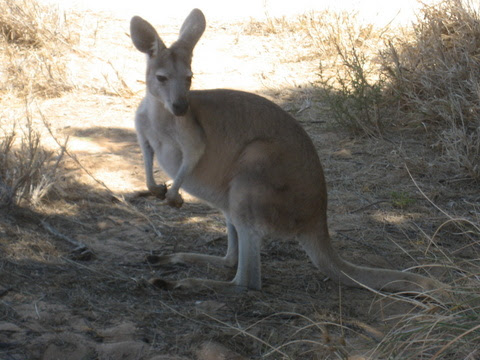
Today we went to the bore water tap near our camp where we can access water for dishes and clothes washing. There was a male emu there with a young chick and another male being kept at bay by the protective dad. They go there to drink from the overflow from the tap, as do kangaroos and all the local birds. The chick was a fluffy, downy little creature and to our delight, he and dad drank their fill while we watched and photographed them. There was a woman at the tap admiring the emu feathers and saying she had bought some but wished she had more. I offered her some which I'd taken from a dead emu, victim of a passing vehicle, and her response was one of horror at the thought. I wonder where she thinks emu feathers come from!!! There is a lot of wildlife around and so far we've seen two whip snakes, a lot of wallabys plus one in particular which sits and watches us while her Joey tucks his head into her pouch for a quick suckle, lots of emus and the ever present butcher birds which beguile us with their songs.... and fish of course as well as rays and turtles.

As the saying goes, "it's a small world" and the people we meet bring that home to us regularly. After the usual icebreaker questions of "where are you going?...have you been? ..are you from?" we discovered a couple who live in the same street we were in before we went to Malaysia, who know all of our old friends who are still in the neighbourhood. We plan a mini reunion after we get home. Another man from Grenfell knows my sister-in-law Carla and her family and so it goes. Two degrees of separation now with the www!

On our last day we drove down to Yardie Creek which is the only permanent water in the entire NP. There is a sandbar blocking the outlet to the sea, which infrequently breaks through, adding more water to the creek. Both sides are steep and there is a walk along the cliff tops with spectacular views into the gorge and along the magnificent coastline. We could see large fish and rays in the water below as well as canoeists exploring the gorge.

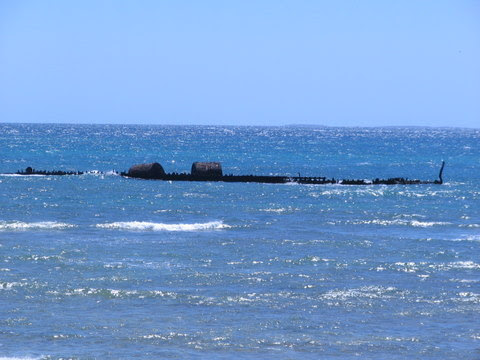
We were sorry to leave the NP and new friends, but we felt we'd enjoyed a fair sampling of the beauty and remoteness of this amazing place. The lighthouse and the wreck of the 'Matilda', are testament to the ruggedness of this coastline, considered the most dangerous in the world.


Thursday, 11 October 2012

Robe River to Barradale Rest Area.

We camped on the river bank under a canopy of Snappy Gums which have white trunks patterned with ant tracks and old injuries. We were grateful for their shade and the beauty of their leaves shimmering in the sunlight. The river there is dry and sandy so there were not as many birds as the previous night. Again we had the company of familiar faces following the same route as we are. The night breeze had a touch of freshness to it, reminding us that we are heading south.


Dampier to Robe River. 5.10.12

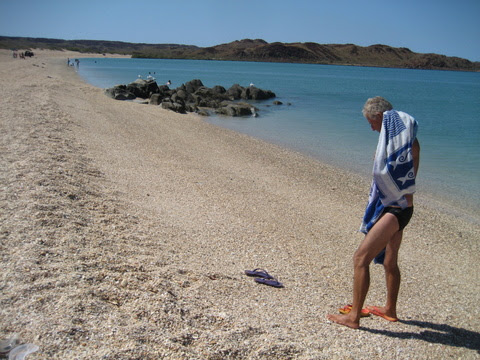
The transit Park in Dampier was so pleasant that we had another three days there on our way south from Cleaverville. Yesterday we went to Hearson's Cove just out of Dampier, for a swim. It was a very hot day and Glenn, who had cleaned out the car, was dripping perspiration. The optWions were shower or swim. The choice was excellent! The cove is a beautiful, crescent-shaped beach consisting entirely of shells which shine and glisten against a background of blue green sea and solid blue sky. After an 'exercise' swim we both lazed in the cool water until the sun got to us, then moved up to a shelter over-looking the beach. We had an ice-cold beer out of the car fridge and with every mouthfull, gratefully toasted our Cush and Ad for their very generous gift.


Last night there was a sausage sizzle, and talk by a local sea captain for a gold coin donation. It brought the camp community together very effectively around the barbie, sharing experiences and knowledge of great campsites and places to see. It ended in a relaxing night of singing and listening to three guitarists with three very different styles. A night of soft breezes under a clear sky so typical of the Pilbara.

On the way from Dampier (on the Burrup Peninsula) across the causeway to Karratha, there are extensive roadworks where they are widening the road. On either side of the road stretch salt pans, starkly white against the deep red soil and towering power poles. Someone with a quirky sense of humour, has been busy during 'smoko' and has created some interesting sculptures to amuse passers-by.

Loch Ness Monster!
Titanic... NB the circling sharks!
ps. I'll have you know that I risked my life crossing the road for these shots!!
After shopping for fuel and fruit and vegetables we were on our way. We stopped about two and a half hours later for lunch at Robe River rest area, down beside the bridge. There we stayed, under a shady tree beside a large pool of water in the otherwise dry river. The birds had congregated in numbers and the corellas were screeching and shouting, oblivious to the hot, gold hush of noon* rest period. There were a lot of tall reeds providing a haven for finches, ducks and other water creatures and the water was clear and fresh.


At least three lots of people camped there were at Dampier with us the night before. Most seem to be travelling south now the hotter, cyclone weather is approaching, much to the dismay of two Dutch girls who were hoping for a lift north. They didn't have a vehicle and didn't want to pay for the expensive bus.

Today we saw the most enormous wide loads we've ever seen. Two huge trucks carrying what looked like complete gas plants slowly approached the bridge, lined up carefully before crossing and then took up the entire width of the road. The pilot car in front stopped all traffic for the bridge crossing and then waved them all past while the huge trucks were pulled over in a layby on the other side of the bridge. Amazing!


Tuesday, 2 October 2012

THE PILBARA...Karratha- Dampier - Cossack - Pt. Samson 24.9.12 - 1.10.12

Our first day in Karratha was spent filling in time with some retail therapy while the car was being serviced. The shopping area was surprising...a large centre in a mining town expected to reach a population of 50,000 in the near future. We spent a small fortune on the car service, bought a few Christmas gifts and treated ourselves to snorkeling gear in anticipation of Ningaloo Reef and it's pleasures. We also bought a fishing book so we can identify the numerous fish we plan to catch.. ( not in the marine park of course)!

Blogger at work.....actually very time consuming. Maybe I will learn to touch type!

We are now in Dampier In the Transit Camp, a pleasant small park which looks straight out to sea. The air is cool and relatively dust free. What a joy!

There is a lot to see around this area. We went to the North West Shelf gas project where there Is a very informative Visitor's Centre explaining how the gas is extracted and from a nearby lookout we could appreciate the enormity of the onshore operation. There is a lot more offshore where Woodside and Partners have another three rigs.

Very large sculpture which stands outside the Visitor's Centre showing two workers helping a third, injured man.

After that we spent a few hours walking through a series of small gorges looking for the petroglyphs cut into the rock faces. There are literally thousands of them there.

Along the roadside were Sturt's Desert Peas bravely flowering right on the edge of the gravel road, and sometimes in the middle of the road. They are prolific at this time of the year and so colourful.

Dampier is also home of the famous 'Red Dog' which has a sculpture in his honor near the entrance to the town.

On our final day here, Sue and Brian, friends from the LadyM cruise arrived. We went to the sailing club for an excellent seafood dinner with a crisp white wine, a beautiful sunset, and a good yarn.
27.9.12 CLEAVERVILLE.

As we were limited to 3 days in the transit park, we drove north about 30kms to Cleaverville, a bush camp managed by the council, overlooking the ocean and widely recommended by fellow travellers, where we paid $7 pn. to caretaker Jim, a friendly, helpful man. The facilities are limited to a dump point and garbage bins, so a chemical toilet was a prerequisite. On the negative side were strong winds, rocky beaches and 'the night of a trillion midges'! On the positive.. interesting company at the nightly happy hour, campfire cooking and shade. At high tide the swimming was great and the shells and stones on the beach very colourful. There were a lot of sea cucumbers on the reef at low tide, a large clam and coral.

Our van was tucked in under the shade of one of the few trees. The coast is harsh and dry.
The entire area is dotted with campers who can stay cheaply for three months until the end of September. After that is the cyclone season and the exposed coast offers little shelter.
COSSACK.

The rebuilt school house.

While based at Cleaverville (there is no 'ville'), we drove further north to the historic town of Cossack, the first port of the North West established in 1863. It thrived for 50 yrs. as a pearling centre and then serviced hundreds of prospectors seeking their fortunes in the Pilbara Goldfields. Eight buildings have been beautifully restored and house informative exhibitions detailing everyday life in the town. The gaol was cool and white-washed and the cells surprisingly large ..and dare I say.. inviting in the heat of the day! The harbour eventually proved unsuitable for larger vessels which transferred to the new jetty at Pt. Samson. Other enterprises moved from Cossack and the town was eventually abandoned completely by the early 1950s.

A highlight of the day was watching a group of young Aboriginal boys, on the last afternoon of the school term, launching themselves from the jetty into the cool channel below. One teacher was videoing them as they leapt and the other was talking to us as he kept a close eye on them as well. One reluctant, chubby boy, sporting jocks with 'HORNY' on the waistband, had many false starts before he finally gathered enough courage to make the leap. All the others applauded him and it was a joy to see his face shine with the achievement. This went on for a good hour by which time they had tired enough to lie on the hot concrete to dry off. Then drinks and lunch and back into the bus. Great entertainment for us!

PT. SAMSON 29.9.12

We drove to Pt. Samson in search of a swim, a shower and of course a large T.V. screen on which to watch the AFL grand final. We found the first two at the pretty beach area and then went to The Tavern for lunch and the game. The crowd was rowdy and well-oiled as expected and the game was great with a 'Swannies' victory. That warmed our NSW hearts of course.

View from the verandah of the Tavern
AFL Grand Final.
The next day we swam while the tide was high at Cleaverville and a turtle kept poking his head up to check our whereabouts while he foraged on the reef for food. It was a beautiful morning. Then we drove into Pt. Samson to watch the NRL grand final at The Tavern again. This time there were about 20 people watching. There isn't the same interest in the west as there is for AFL.
Lamb roast on the campfire for dinner was delicious.
We have been watching the Common Sandpipers as they rush around our caravan looking for food, bobbing their heads up and down. They don't take much notice of us providing we stay still.
More snorkelling today, and the usual campfire gathering. We will be sorry to leave these new friends when we move on tomorrow, but expect to meet some who are travelling the same way south.