Monday, 19 November 2012

Geraldton 31.10.12 to Perth.

We've had a busy time so far in Geraldton and you'll all be delighted to know we have a new broom purchased from IGA which has a comprehensive supply of Asian goods. At last!

We caught up with my nephew Jason and had a delicious dinner at 'Tides' overlooking the harbour. We continued the chat the next night when he came to sample Glenn's chicken curry. It was great to see him so well and happy here.

Behind the Visitor's Centre is the old goal with beautiful thick, white-washed walls, small cells and a terrific collection of stones, many of them presented as highly polished spheres. The colours and patterns in the rocks were really amazing. Most of the cells are rented by artists and craftsmen who display and sell their work there. Each cells has the original heavy door with some of the original locks still in place.

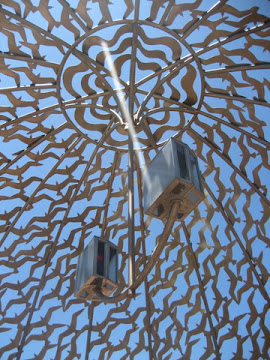
From there we drove up to the HMAS Sydney II Memorial which overlooks the harbour. We had an informative and enthusiastic guide who explained the various features and the significance of each one as we walked around. The silver dome made of 645 seagulls, represents each sailor lost and the wall of remembrance lists each man. With the discovery of the wreck, the final part of the memorial has been installed.. a pool of remembrance.

Next was the Museum which kept us interested for the next few hours. It has a permanent exhibit presenting the history of the Batavia shipwrecked near the Abrolhos Islands, insights into the Aboriginal history as well as some smaller exhibitions. I particularly liked the one showing dolls made by local people, hand stitched and naive.

There was also an exhibition featuring the work of Max Dupain, one of Australia's most renowned photographers, with over 80 striking images from the 1940s to the 1970s. He was famous for his modernist, documentary style of photography and his images of post-World War II Australia are widely regarded as important records of a changing society. The photos of steel girders and other architectural features were superb.

We went to the Byzantine style St Francis Zavier Cathedral where the Bishop was saying Mass and a relic of the saint was on display. We took a guided tour of the crypt, unusual in an Australian church, which had displays of early vestments, and historic memorabilia. The architect was a Monsignor Hawes, a man of many talents who designed other buildings in the town as well. He felt that a Byzantine style church was more suited to the Meditterean climate of the area than a Gothic cathedral.

My nephew Jason, works in a caravan supplier/repair business and offered us a great price on a new fridge for the van. Ours has been struggling on gas and is showing its age in other ways. The fact that the door jumped off on the atrocious road from Drysdale station didn't help!! The 3-way fridge had to come from Perth so we headed out of Geraldton to look around the local area while we waited for the delivery.

Firstly we headed north to the recommended Coronation Bay but the wind was almost gale force. The kite surfers were loving the conditions but they were unpleasant for campers so and we opted to go south and inland to Greenough and Walkaway.

Just before Greenough we saw the bizarre sight of trees growing horizontally. They are an icon of the area and opinions differ as to the cause of their surreal appearance. Some say it is the result of prevailing winds but others say the roots hit a chemical layer in the soil which effects the trunk structure. The village of Greenough is renowned for its restored heritage buildings which are charming. There are eleven stone buildings, remnants of a thriving 19th century pioneer community, and a lovely cafe.

After we left the village we saw windmills on the horizon and gradually approached a wind farm with 54 giant turbines dominating the surrounding rolling hills. They pump massive amounts of electricity into the grid and pay for the cost of construction, maintenance and decommission in three to six years, of a twenty five year life. They have no carbon emissions after construction.

We drove through back lanes looking for Ellendale Pool, recommended as a great campsite. True enough, it is a scenic, well treed area on the edge of a long pool with cliffs across the water. There are flush toilets, water, cold showers and a swimming hole, all for $5 pn. We were welcomed into the established group for happy hour and are at the moment spending our second day here. The heavens opened in the night and we have our first rain since Melbourne. over six dry months. It's now quite muddy and cold and we don't like it but the land does. We are enjoying the peace and the bird watching.


Four days later we were back in Geraldton to pick up our new fridge. Jason got us a trade price which we were very grateful for and he and Glenn installed it. Jase was great and even managed a front for the fridge to match our decor! Our thanks Jason.. Wonderful nephew.

We went back to Ellendale Pool for the night and the next day drove south along the Indian Ocean Road which follows the coast closely. We drove through Dongara and Port Denison to Jurien Bay and then stopped on a deserted beach for lunch and soaked up some sun out of the wind. The coast is sparsely populated and sparsely vegetated and the wind is a constant at this time of the year. The reef is visible a few hundred metres off shore and the sand blindingly white against the deep blue ocean

We stayed at the caravan park at Cervantes and had to unearth our woollies as it was so cold. Next day we drove a bit further south to The Pinnacles in the Nambung NP. We had to unhitch the van and leave it in the car park as the track between the limestone pillars was narrow. It was an amazing sight to see hundreds of pillars of differing heights dotted over the undulating landscape. I loved the soft yellow ochre colour of the sand against the sky and dark blue sea. While we were there Glenn had an overwhelming urge to do a 'Billy Connelly' streak!!!

The sandhills at Cervances were the whitest we have ever seen and they often just rose above the horizon as we drove towards Perth.
We headed south, ducking in and out of the small places along the coast. We ate our sandwiches on the pretty beach at Lancelin and watched a lone dolphin cruising under the wharf where the fisherman were, and along the beach in front of us. It was a joy to watch as it moved with incredible ease and grace. They are beautiful creatures.


Sunday, 18 November 2012

Kalbarri to Geraldton

We took our time walking the cliff tops just south of Kalbarri where there is an extensive wheelchair friendly pathway affording spectacular views of the rugged coastline which falls within the Kalbarri NP. It weaves its way along through wildflowers for eight kilometres, with steep drops down to the rocks below. It was extremely windy, beautiful and exhilarating.

 
We turned off the Coast Highway on a gravel road to go to Hutt River Principality. Glenn was particularly interested in the history of this place and the man who was Prince. We went to the chapel where the thrones are and Glenn sat in the Prince's chair. We had an amazing tour with the Prince who explained many of the documents he had from foreign Heads of State and his battle against the government wheat quotas which led to his succession from Australia. He had 13000 acres usually planted with wheat and the new quotas meant only 100 acres could be put to wheat. His livelihood was threatened and he objected but to no avail. Eventually he lawfully created his own country and has stamps and coins and issues visas to those who cross the border from Australia to the Hutton River Principality. He is an extremely feisty man in his eighties, very happy to talk about his life.

There were some very interesting sculptures around the garden, all constructed from pieces of machinery. Apart from this grader, there was a sailing ship and a motorbike.
Once back on the coast road we stopped in to look at Coronation Beach which had been recommended as a campsite but there was a howling gale making a beautiful spot unappealing to all but the kite surfers who were loving it!

Next stop Geraldton.


Monday, 29 October 2012

Kalbarri 26.10.12

The drive to Kalbarri was a feast for the eyes with wildflowers in full bloom along the way. We are late in the flowering time but the colours are still brilliant and flowers plentiful. One of the most amazing was the Plumed Grevillea which carries the flower heads high above the foliage. The edges of the road were lined with their impressive yellow/white flowers.

We went into the Kalbarri NP and walked to the Ross Graham lookout which has views down into the gorge. The lookout was named after the first headmaster of the Kalbarri Primary School, who was deeply committed to preservation of the environment. Sadly, he died at age 31. We then went down into the gorge for a quick, refreshing dip in the Murchison River. It was very hot. I went in with my sunglasses on and discovered a bit later that I didn't have them. We did a search of the bottom and eventually Glenn found them. Lucky!
We are now in Murchison C'van park in Kalbarri with fresh drinking water, shade, showers, power and mobile service. How good is that?
Since we've been here we have driven along the cliff tops to check out the surf breaks and found a huge wave working at Jaques Point ..... a perfect break with a long ride into the beach. Glenn took pictures to send to son-in-law Adam to drool over! We also went out for lunch and swam at the beach over the road from the c'van park. Nothing too strenuous today.
A fellow camper - Stumpy Blue Tongue Lizard.

....... And another

I also spent hours online trying to fill in the house-exchange gaps for our trip to Europe next year. Hope there are some replies.


We went back to the NP today to photograph some more wild flowers and can only imagine how stunning they must look at the height of the season. We will come back again at the right time for another look.

While we were there we walked The Loop Walk to Nature's Window, a natural rock arch which superbly frames an upstream view of the Murchison Gorge and its switchback course. The walk leads steeply down to the river and follows its path through the gorge for a long way and then rises up to return along the cliff tops. There is another lookout at the start of the Z Bend Trail which gives spectacular views of the river and the surrounding plateau as well.

On our last day in Kalbarri we went to the Rainbow Jungle, a breeding centre for parrots and spent almost three hours there marvelling at the astonishing number of beautifully coloured parrots. Most of them were Australian with a few exotics thrown into the mix. The centre has a wonderful success record for breeding parrots, with the exception of a pair which cost $8,000! No wonder the black market trade in birds is so lucrative. We came away with a greater appreciation of the damage done by people who release birds into the wild, in areas which are not their usual habitat. There were several scathing comments made about 'greenies' who release caged birds and who hug trees and own a cat!!! The Eastern Rainbow Lorikeet is creating havoc in WA where it has grown to plague proportions, threatening many local species. So too is the Galah.

Macaws
 
Gang gang cockatoos .... Love their top nots!
 
We lost our broom when .....GLENN!. .JENNI! ..... depends who you talk too....... left it hanging outside the van when we left Monkey Mia. We haven't replaced it yet. Do you know how difficult it is to buy a small Asian hand broom when you are away from the big smoke??? We have tried everywhere with no success. If Geraldton hasn't got one we will be distraught, as nothing else will do the job. The broom we want, known as an Amah's broom, has long, soft, feathery 'bristles' which get the sand out of all the caravan crevices. Surely Geraldton will have an Asian shop of some description!

And, yes, I hear you say, "is that all they have to worry about? "

We finished our day with a good read on the beach in the late afternoon sunshine and then opened a bottle of red to calm our nerves. To your good health!


Carnarvon to Denman and Monkey Mia.

After leaving Carnarvon we were back to a flat, arid, treeless landscape which instantly sent me nodding off. In no time at all, surprisingly, we were at Gladstone lookout, a mesa which had three weird cairns assembled out of rocks with messages written on them. They were a mixture of memorials to departed loved ones, autographs of travellers, a large assortment of gnomes, bras, teapots and stuffed animals! In quite a few places we've seen various collections of thongs, workboots, underwear, hard hats, postcards, photos. All except the last two were hanging on trees.

We spent the night at Hamelin Pool Station, which had the very best amenities block we've ever seen and a camp kitchen equally as good. The bird life was amazing, and together with a young family of avid twitchers with keen eyes and impressive knowledge, we saw the White-Winged and Splendid Fairy-wrens, the Red-kneed Dotterel, Common Greenshank, Eurasian Coot and a Whiskered Tern, as well as three Brown Falcons on the roof of the old barn. A great day!

Stromalite
The next morning, we went to Hamelin Pool Marine and Nature Reserve to look at the Historic Telegraph Station and the stromatolites. The stromalites are colonies of micro-organisms that resemble the oldest and simplest forms of life on earth around 3.5 billion yrs ago. They were the first life-form which produced oxygen which enabled other forms of life to evolve.
fabulous shadows cast by walkway over stromalite beds.
 
An old wool dray and water tank behind.... exhibits in the museum precinct at the Historic Telegraph Station.
The Shearing Hall Of Fame had an excellent collection of memorabilia relating to the pastoral and shearing industries, a huge range of steam engines, trucks and farm machinery, as well as the salvaged lifeboat from the German raider Kormoran which was responsible for the demise of HMAS Sydney II, in1941. The photographic display documenting the shearing industry and the life of local families in the 1950s was impressive. Also documented was the development of the railhead which facilitated the loading of wool onto ships for transport to Perth. Even more amazing was the fact that the museum was open and unattended!

One Mile Jetty which is currently being restored.
Nearby is the One Mile Jetty, built in 1897 to facilitate the export of wool and livestock to Freemantle. As we were walking out onto the jetty, two Aboriginal boys passed, dripping wet and carrying hand spears. They pointed to the men we could see on the beach and said they were going to fish with them. They had already caught big mullet they said. The younger boy who was about eight called the older boy, about 13, 'uncle'. We were pleased to see traditional Aboriginal culture in action as it underpins a sense of identity.
We are constantly amazed by the work done in NP and Reserve areas to protect and maintain pristine areas, while at the same time encouraging tourists to explore and enjoy them. The signage, amenities and information available is remarkable. Our annual Western Australia NP Pass, which cost a mere $50, gives us access to every NP in the state, and is well worth the expense. Camping fees within the parks are $5 pp pn, for seniors or $7pp. + $11 park entry without an annual or seasonal pass.
Today, we drove to Denham, stopping on the way to look at a few bush campsites we'd heard about along the coast and then went to Eagle Bluff. There is a boardwalk high above Shark Bay from which you can sometimes see Dugongs, rays and sharks swimming above the vast seagrass beds, but, unfortunately, it was so windy we were almost blown off the face of the planet and retreated to the car!

We also stopped to look at Shell Beach which consists entirely of shells to a depth of 10 metres. The most interesting thing was the electric fence crossing the isthmus which Is designed to keep feral animals out of the Francois Peron NP. There is a considerably successful programme of eradication of goats, rabbits, cats and foxes and reintroduction of threatened native species such as the bilby.
Denman is a pretty, seaside town with a Visitors Centre where we obtained all the information we needed for entry to Monkey Mia and the Francois Peron NP.
We bought a few supplies and drove to Monkey Mia. The resort has a lot of accommodation and tour options, restaurant, canoes for hire, shop and attractive beach with a jetty. There is a no go zone for boats and swimming where the dolphins are fed daily.
The next morning the beach was lined with tourists waiting for the dolphins to come in for the first feeding session of the day. Eventually, there were six which rolled, smiled and performed for the tourists and gratefully accepted the fish on offer.
After packing up and vacating the caravan park, we went on a catarmaran cruise for 2.5hrs, spotting dolphins, dugong and turtles. We saw a lot of dugongs for the first time in the wild. They surface briefly for air and then continue feeding on the extensive sea grass beds which occur in this area. Some of them were sleeping and looked like large, blubbery, brown lumps on the surface of the sea.

Our captain ....... Left foot on accelerator and right foot on steering wheel. Head stuck out wildlife spotting!!!!!!
The cruise also took us to a working pearl farm where we tasted pearl meat for the first time. It was surprisingly sweet. We saw the delicate the work of seeding the pearls, where the seeder opens the shell with special spreaders, then uses a scalpel to cut a small slit in the flesh where the seed is implanted. Over a period of time the seed is covered with nacre (mother of pearl), as the oyster tries to get rid of the foreign seed. A round pearl takes considerably longer to form than a blister pearl. That is the main reason why blister pearls are less expensive.

 
We planned to go into The Francois Peron NP but decided against going further than the homestead because the conditions were not suitable for trailers or vans. The strong, constant winds were also unpleasant. We backtracked to Denman to the visitors Centre for a camping permit and went to Eagle Bluff for the night. It was a bit protected in behind the dunes and we had no sooner set up, than the family from the night before arrived. They told us they got bogged on the way into the Francois Peron NP and had to dig themselves out of the sand, so they turned back. It was great to have some company and people to share some of the vanilla slice I'd made. They have 8yr old twin girls and an 11yr old boy.

Eagle Bluff campsite.

The wind dropped the next morning and we spent a pleasant few hours on the beach with nary a soul to be seen. Bliss! We revisited Eagle Bluff and saw huge manta rays and at least 10 sharks at one count in the waters below. No wonder it's called Shark Bay and lucky we were swimming/lolling in ankle deep water only, just before.

After lunch we covered a bit of distance and free camped at Nerren Nerren under a large shady tree, about 120kms short of Kalbarri.

Cards score: Glenn 14 Jenni 18


Canarvon WA 20.10.12

It was great to see the change from arid, treeless plains to the lush productive plantations of the Gascoyne River as we approached Carnarvon. We checked into the Big 4 caravan park which has more don'ts than do's. Washing machines are $5, the most expensive we have seen so far and there is an extra DIY charge of $5 each to wash car or van. Makes me wonder what the nightly tariff of $35 is for and explains why there are enormous numbers of travellers opting for off road camping, especially as most have toilet and shower facilities of their own.

We spent the morning catching up on washing, email etc. and then went to the pub for lunch. We sat overlooking Carnarvon's central waterway, known as the Fascine (literal meaning is 'water held back by sticks'), which is lined with palm trees and ate very good snapper, prawns, squid and scallops with a cold beer!

From there we drove along the memorial drive where there is a plaque stating the name and rank of every man who perished on the HMAS Sydney II, and a palm tree growing behind. A big effort we thought.

The town is dominated by the OTC dish which was built in conjunction with NASA and was involved in the Apollo space missions. We climbed to the platform from where there is a panoramic view of the town, plantations and surrounding countryside. The phone rang while we were standing there and I had a long conversation with my brother Peter. The reception was excellent... maybe due to the height!


The plantations on the fertile river delta are watered by the large artesian water supply and produce tropical fruits, melons, vegetables and gourmet treats of all description. We followed the Gasgoyne food trail which led us along one side of the river and then the other, to products available for sale directly from the producer, and came away with delicious peaches and nectarines, beans, pumpkin, mango, eggplant and eggs. It was interesting to cross the bridge and look down at a river of sand and red dirt with pumps sitting on the surface, drawing water from well below the surface! Quite amazing really!

Gascoyne river bed with pump in distance on the right.
produce (Spanish onions and bananas in distance) grown on river banks.


Saturday, 20 October 2012

Warroora Station, Quobba Blowholes. 19.10.12


I am sitting the car writing this as Glenn pumps up the tyres. We have just driven out of 14 Mile, (a wilderness camp on Warroora Station where we spent last night), over a very rough, sandy track and are about to drive on the bitumen again. The camp was behind the sandhills on a beautiful stretch of coastline and reef but the wind is up and unpleasant. When we mention the wind the response is "well, it is October!". We've been told it is the same all the way from the Cape to Kalbarri.

Last night we camped at Pt. Quobba... more wind and a similar site behind the dunes. The reef is right off the beach but too windy to snorkel but the blowholes were working really well with the big swell. The huge sign warning that king waves kill was a bit intimidating but we went close to see the blowholes while we kept a close watch on the waves as they rolled in.

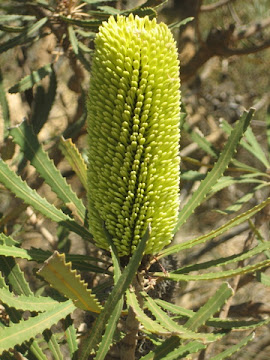
Vegetation was very sparse as we drove along the coastline behind the sandhills and very low growing. The banksias were only a few feet high, their bright orange heads being battered by the strong winds. We saw feral goats, kangaroos and emu. The sheep were interesting in that they had not been docked and were sporting very long tails which swayed and bounced as they ran from the road. They were all colours from light to almost black and often piebald as well. Most stations are unfenced so domestic animals are an added risk for drivers. The emus wander slowly across the road almost without acknowledging our presence. The goats are too smart and take off early. The sheep are so dumb. Yesterday a flock was crossing ahead of us and it split into two groups.. one crossing and the other staying put. One sheep looked from one side to the other, turned clockwise and then anti clockwise in the middle of the road in a bewildered state of indecision in front of the car. We watched with disbelief and a great deal of amusement until it eventually ran off. Good thing we were at a standstill by then!!

We drove north to look at Red Bluff which is a well reputed surf break but the swell wasn't there so the point break wasn't working. I think Glenn was relieved as he would have hated watching a good break from the beach.

On the way back we stopped at the cairn erected in remembrance of the 645 lives lost when HMAS Sydney II went down off the coast here in 1941. It's final resting place was not discovered until 2008. The memorial was funded by one of the crew who was removed from the ship for medical reasons just before it sailed from Freemantle on its final voyage. Very moving.